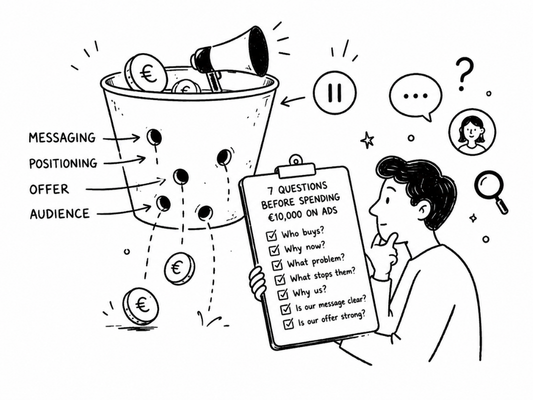
One of the most expensive assumptions a business can make is believing that poor sales automatically mean a poor product.
Sometimes that's true. More often, the product is perfectly capable of solving a real problem. The challenge is that customers don't immediately understand that from the website, landing page, or marketing message. I've worked with businesses that had genuinely strong products and genuinely confusing messaging. Not because the founders didn't understand their customers, but because they understood the product too well. When you spend months or years building something, it's easy to forget what it feels like to encounter it for the first time.
You know how everything works. You know the terminology, the benefits, the process, the details. Your customer doesn't. A weak message doesn't mean a weak product. It often means there's a gap between what you offer and what people understand.
A weak message doesn't mean a weak product. It often means there's a gap between what you offer and what people understand.
The Curse of Being Too Close
Founders and teams often assume certain things are obvious because they've spent so much time thinking about them. The result is messaging that makes perfect sense internally but creates confusion externally. Instead of clearly explaining the problem being solved, businesses often jump straight into features, industry terminology, or internal language that customers have never used. The irony is that the more expertise a business has, the easier it becomes to accidentally make things harder to understand.
Customers don't arrive with the same context you have. They're usually trying to answer a much simpler question: "Is this for me?" If they can't answer that quickly, they'll move on.
- High website traffic but low conversion rates
- Customers asking questions your homepage should already answer
- Sales calls that begin with lengthy explanations of what you actually do
- Prospects struggling to understand how you're different from competitors
- Testimonials describing your product better than your own website copy
Your Customers Already Wrote Your Best Copy
One of my favourite places to look for messaging ideas isn't a brainstorming workshop or a marketing playbook. It's customer conversations. Customers often explain the value of a product more clearly than the business itself. Read through reviews, interview transcripts, customer emails, support tickets, or sales call notes and you'll start noticing patterns. Certain phrases appear repeatedly. Similar frustrations show up again and again. Customers describe the same outcomes using surprisingly consistent language.
Those patterns are valuable because they reveal how people naturally think about the problem you're solving. What words do customers use before they find you? What problem are they trying to solve? What concerns nearly stopped them from buying? What finally convinced them to say yes? The answers often belong on your homepage far more than the language from your product roadmap.
Customers can't buy what they don't understand.
Clarity Beats Cleverness
Many brands spend a lot of time trying to sound different. They create new terminology, invent frameworks, write headlines that are clever and memorable. The problem is that customers aren't usually looking for clever. They're looking for clarity. The strongest messaging doesn't necessarily sound unique. It simply helps customers recognise themselves and their problem as quickly as possible. That's why some of the highest-converting websites are surprisingly straightforward. They explain who the product is for, what problem it solves, and why someone should care. No decoding required.
The goal of your website isn't to impress people. It's to help them understand.
A Quick Messaging Audit
If you're unsure whether your messaging is helping or hurting conversion, it's worth asking: Can a first-time visitor explain what you do within ten seconds? Are you using customer language or internal language? Would your customers describe the product the same way you do? What questions repeatedly come up in sales calls? Are you explaining features more clearly than outcomes? The answers usually reveal where the biggest opportunities for improvement exist.
When growth slows down, it's tempting to assume you need more traffic, more features, or a better product. Sometimes what you actually need is clearer communication. The best messaging rarely comes from staring at a blank document trying to sound smarter. It comes from listening carefully to customers and reflecting their language back to them.
The words that convince customers to buy are often the words customers used first. The clearest brands aren't always the most articulate. They're the ones that listened most carefully to the people they serve.