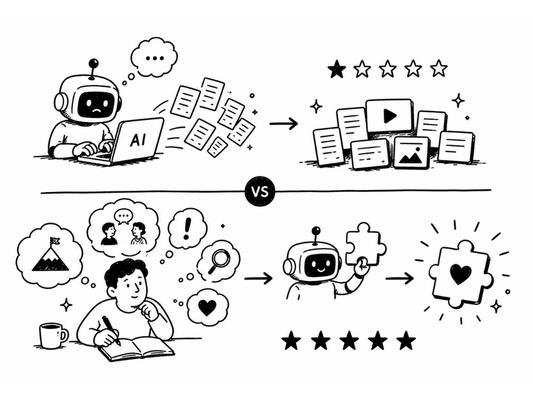
Everyone is using AI to produce more content. That's exactly why producing more content is becoming less valuable.
Spend a few minutes on LinkedIn and you'll quickly find examples of people using AI to create more blog posts, social media updates, emails, newsletters, and marketing assets. There's nothing inherently wrong with that. The challenge is that as AI makes content creation easier, content itself becomes less scarce. When everyone can produce more content, simply producing more of it becomes less of an advantage. What many businesses actually struggle with isn't content creation. It's understanding. Understanding their customers. Understanding why people buy. Understanding what customers are really trying to achieve and what gets in their way. That's where AI becomes genuinely interesting.
The most powerful use of AI isn't generation. It's understanding.
The Information Businesses Already Have
Most companies are sitting on a surprising amount of customer insight. The problem isn't access to information. The problem is finding the time to make sense of it. Inside almost every business you'll find customer interviews that were conducted but never fully analysed, sales call recordings full of objections and buying signals, support tickets that reveal recurring frustrations, survey responses that nobody has had time to review properly, product reviews filled with customer language and feedback, and internal notes scattered across different systems.
Individually, each of these sources contains useful information. Together, they often tell a remarkably clear story about what customers care about, what they struggle with, and why they make decisions. The challenge is that analysing all of this manually takes time. Most teams simply don't have enough of it.
Where AI Creates Real Leverage
This is where AI has completely changed the way I think about research and customer understanding. Rather than using AI primarily to create content, I've found it far more valuable for identifying patterns across large amounts of information. It can surface recurring objections, group similar themes, identify common motivations, and highlight language customers repeatedly use when describing problems. Tasks that might have taken days or weeks to synthesise manually can now happen in a fraction of the time. That doesn't mean AI replaces human judgement. It means humans can spend less time organising information and more time thinking about what it means.
AI can process information faster than humans. Humans still decide what matters.
The Difference Between Data and Insight
One of the biggest misconceptions about AI is that more data automatically creates better decisions. It doesn't. Most businesses already have access to more information than they know what to do with. What they lack is clarity. The real value comes from turning information into insight. Knowing that hundreds of customers contacted support isn't particularly useful on its own. Understanding that many of those customers were confused by the same step in the buying process is far more valuable. Similarly, reading a single customer review may not change much. Discovering that the same concern appears across hundreds of reviews can completely change how you think about messaging, onboarding, or product development.
- Analysing customer interviews for recurring themes
- Identifying patterns across product reviews
- Summarising survey responses at scale
- Categorising support requests by type and frequency
- Extracting customer language for messaging
- Surfacing recurring objections from sales calls
Better Inputs Create Better Outputs
Many businesses use AI at the end of the process. They gather information, make decisions, and then ask AI to generate content. The bigger opportunity is using AI much earlier. Use it to analyse interviews. Use it to synthesise customer feedback. Use it to identify recurring themes across support tickets. Use it to uncover language customers naturally use when describing their problems. When those insights inform your messaging, content, positioning, and product decisions, the output becomes significantly stronger.
Better customer understanding creates better content. Not the other way around.
The Teams That Will Benefit Most From AI
I don't think the biggest winners from AI will be the businesses producing the most content. I think they'll be the businesses that learn faster than everyone else. The companies using AI to understand customers more deeply will make better product decisions, communicate more clearly, spot patterns sooner, identify opportunities earlier, and spend less time guessing what customers want. In many ways, AI is becoming less of a content tool and more of a thinking tool. The businesses that recognise that shift will have an advantage that's difficult to replicate.
The conversation around AI often focuses on speed and efficiency. Those benefits are real. But the most valuable thing AI has helped me do isn't create more content. It's helped me understand people better. Because at the end of the day, growth still comes from understanding customers. AI simply gives us a much faster way to learn. The teams using AI to understand customers will outpace the teams using it to fill content calendars.