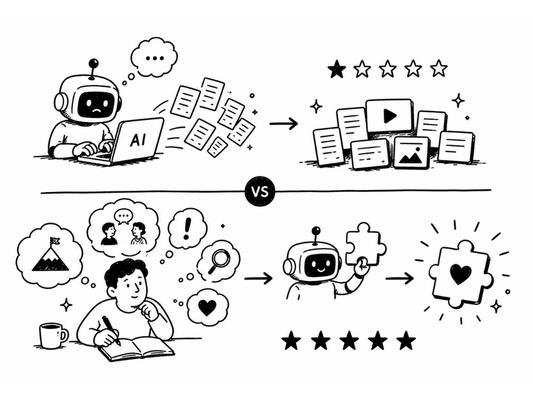
When growth slows down, advertising is often the first solution businesses reach for. More budget should mean more traffic, more customers, more revenue. Sometimes that's true. But I've also seen businesses spend thousands on paid advertising only to discover that traffic was never the problem in the first place.
Advertising is rarely a solution on its own. It's an amplifier. If your positioning is clear, your message resonates, and your website converts, advertising can help you scale. If those things aren't working, ads will simply help more people experience the same confusion. Before committing a serious budget to paid acquisition, these are the seven questions I'd want answered first.
Advertising doesn't fix weak foundations. It amplifies them.
1. Do You Know Who Is Actually Buying From You?
Most businesses have an idea of who their customers are. Far fewer understand them deeply. The goal isn't to know their age range or job title. It's to understand what motivated them to start looking for a solution, what alternatives they considered, what concerns they had, and what ultimately convinced them to buy. If you don't know why customers are choosing you today, it's going to be difficult to attract more of them tomorrow.
2. Do You Know Why They Chose You Over Alternatives?
Every customer is making a comparison, whether you realise it or not. They're weighing you against competitors, existing habits, doing nothing, or entirely different solutions. If you can't clearly explain why customers choose you over those alternatives, your advertising probably can't either. The strongest marketing messages are usually built around one simple truth: understanding what customers value most when they're making a decision.
If you can't clearly explain why customers choose you, your ads probably can't either.
3. What's the One Thing a New Visitor Needs to Understand?
Many businesses try to communicate everything at once. The result is often a homepage filled with features, benefits, and promises all competing for attention. New visitors don't need your entire value proposition immediately. They need enough clarity to understand whether they're in the right place. Ask yourself: "What's the one thing someone needs to understand within the first few seconds?" That answer should guide your messaging, landing pages, and advertising.
4. What's Stopping People From Converting?
One of the biggest mistakes businesses make is assuming that more traffic will solve a conversion problem. If visitors are already arriving but not taking action, the issue is often somewhere else. Common sources of friction include a lack of trust, unclear messaging, pricing concerns, poor user experience, missing information, or weak differentiation. Advertising doesn't remove these obstacles. It simply sends more people toward them.
5. Is Your Landing Page Doing What a Good Salesperson Would Do?
A good salesperson doesn't just describe a product. They answer questions, address concerns, build confidence, and guide someone toward a decision. Your landing page should be doing exactly the same thing. Does it clearly explain the problem being solved? Does it show why this solution is different? Does it address common objections? Does it build trust through proof? Does it make the next step obvious? If your page struggles to convert existing visitors, more traffic is unlikely to fix the issue.
Sending more traffic to a weak landing page is like pouring water into a leaking bucket.
6. Do You Have a Clear Reason to Be Chosen?
Many businesses compete on features. Customers rarely buy features. They buy outcomes, confidence, convenience, trust, status, peace of mind, or solutions to problems that genuinely matter to them. A clear reason to be chosen goes beyond a product specification sheet. It explains why your business is the right choice at the exact moment a customer is deciding. The clearer that reason is, the easier every marketing activity becomes.
7. Can You Measure What Actually Matters?
It's easy to become focused on clicks, impressions, and reach because they're visible and immediate. The challenge is that none of those metrics guarantee business growth. Before increasing advertising spend, make sure you're tracking outcomes that actually matter: revenue, conversion rate, customer acquisition cost, customer lifetime value, retention, and repeat purchases. Without this visibility, it's possible to optimise campaigns while quietly making the business less profitable.
- Have we spoken to customers recently?
- Do we know why people buy from us?
- Can a new visitor understand our offer quickly?
- Do we know where conversion friction exists?
- Is our landing page converting effectively?
- Can we clearly explain why we're different?
- Are we measuring business outcomes, not just marketing metrics?
If the answer to several of those questions is "not really," that's where I'd invest time first. The best advertising campaigns rarely succeed because of clever targeting or creative alone. They succeed because the business behind them already understands its customers, communicates clearly, and converts effectively.
The best use of a media budget isn't fixing a conversion problem. It's amplifying something that's already converting.
Before spending €10,000 on ads, I'd spend time making sure the foundations are strong enough to benefit from it. Advertising works best when it amplifies something that's already working.